
What you will learn in this chapter
- Explain the structure of a typical anther and the formation of pollen grains (microsporogenesis).
- Draw and label the structure of an anatropous ovule and a mature 7-celled, 8-nucleate embryo sac.
- Differentiate autogamy, geitonogamy and xenogamy, and describe outbreeding devices.
- Explain double fertilisation and the ploidy of zygote and primary endosperm nucleus.
- Describe the development of endosperm, embryo, seed and fruit.
- Explain apomixis, polyembryony and parthenocarpy with NCERT examples.
📘 Open this chapter on NCERT official website (ncert.nic.in) · The same NCERT chapter is taught in both CBSE and UP Board.
Sexual Reproduction in Flowering Plants — Notes
Revise these first (prerequisites)
- Basic parts of a flower — sepal, petal, stamen, pistil (Class 6–7 level)
- Mitosis vs meiosis: meiosis halves the chromosome number (2n → n)
- Meaning of haploid (n) and diploid (2n)
- Plant life cycle: seed → plant → flower → fruit → seed
Flower = the reproductive part of a plant
A flower is not just for looking beautiful — it is the reproductive organ of the plant. Its male part is the stamen (पुंकेसर) and its female part is the pistil (स्त्रीकेसर). Just as the kitchen is the place in a home where food is made, the flower is the place where seeds are made.
Pollen grain = the male 'packet'
Pollen grains are formed in the upper part of the stamen, the anther (परागकोश). Male gametes are formed inside each pollen grain. Think of it as a sealed courier packet: a tough outer cover (exine) with the actual contents (male gametes) inside.
The egg inside the ovule
The swollen lower part of the pistil is called the ovary (अंडाशय). Inside the ovary are ovules (बीजांड), and inside each ovule is an embryo sac (भ्रूणकोश) containing the egg cell. This ovule later develops into the seed.
Pollination = pollen reaching the stigma
Pollen has to travel from the anther to the stigma (top of the pistil) — this is called pollination (परागण). This is done by wind, water, insects or birds. A flower cannot move on its own, so it needs 'delivery partners'.
Fertilisation = fusion of male and female gametes
After landing on the stigma, the pollen grain forms a pollen tube that grows to the ovule. There, a male gamete fuses with the egg; this is fertilisation (निषेचन). Flowering plants have two fusions, not one, so the process is called double fertilisation.
What forms later?
After fertilisation: ovule → seed (बीज), ovary → fruit (फल). The mangoes or peas you eat are the result of this process. Inside the seed, a tiny baby plant (embryo) stays peacefully 'asleep' until it gets the right season.
Quick check ✔
1. In which part of the flower are pollen grains formed?
2. What does the ovule develop into after fertilisation?
Basics clear? Now move on to Learn in Detail 👆
As per NCERT 2026-27 — every point you need for the board exam.
Parts of a flower
Stamen (पुंकेसर) = male part: anther + filament. Pistil / carpel (स्त्रीकेसर) = female part: stigma, style, ovary. Androecium = all the stamens, gynoecium = all the carpels.
Structure of the anther
A typical anther is bilobed and dithecous — 4 microsporangia. The wall has 4 layers: epidermis, endothecium, middle layers, tapetum (innermost; nourishes the developing pollen).
Microsporogenesis
Pollen mother cell (2n) → meiosis → microspore tetrad (n). Each microspore later develops into a pollen grain.
Pollen grain
Outer wall exine = sporopollenin (the most resistant organic material); sporopollenin is absent at the germ pores. Inner wall intine = cellulose + pectin. A mature pollen grain has a vegetative cell (large) + a generative cell (small). In over 60% of angiosperms, pollen is shed at the 2-celled stage.
Ovule (बीजांड)
Attached to the placenta by the funicle; hilum = where the funicle joins the ovule body. Integuments, micropyle, chalaza, nucellus. The embryo sac lies inside the nucellus.
Megasporogenesis + embryo sac
Megaspore mother cell (2n) → meiosis → 4 megaspores, only 1 functional. Monosporic development: 3 mitotic divisions → 7-celled, 8-nucleate embryo sac — egg apparatus (2 synergids + 1 egg), 3 antipodals, 2 polar nuclei in the central cell.
Types of pollination
Autogamy (same flower), geitonogamy (another flower of the same plant — genetically similar to autogamy), xenogamy (a different plant — genetically different pollen). Cleistogamous flowers (Viola, Oxalis, Commelina) never open → assured seed set.
Agents of pollination
Wind: light, non-sticky pollen, feathery stigma (grasses, maize). Water: Vallisneria, Hydrilla, Zostera (sea grass). Insects: coloured, scented, nectar-rich flowers. Amorphophallus has the largest flower; Yucca–moth mutualism.
Outbreeding devices
Ways to prevent self-pollination: pollen release and stigma receptivity at different times, anther and stigma at different positions, self-incompatibility, unisexual flowers (castor, maize = monoecious; papaya = dioecious).
Artificial hybridisation
Emasculation (removal of anthers from a bisexual flower) + bagging (butter paper bag) → dusting of desired pollen → rebagging.
Double fertilisation (दोहरा निषेचन)
The pollen tube releases 2 male gametes through a synergid. 1st male gamete + egg = syngamy → zygote (2n). 2nd male gamete + 2 polar nuclei = triple fusion → PEN (3n). Found only in angiosperms.
Endosperm, embryo, seed
Endosperm forms first (it provides nutrition to the embryo). Coconut water = free-nuclear endosperm, white kernel = cellular endosperm. Dicot embryo: 2 cotyledons, epicotyl, hypocotyl. Monocot: 1 cotyledon = scutellum, coleoptile, coleorhiza. Perisperm = residual nucellus (black pepper, beet).
Fruit
Ovary → fruit, ovule → seed. False fruit: the thalamus also contributes to fruit formation (apple, strawberry, cashew). Parthenocarpy = fruit without fertilisation (banana) — seedless.
Apomixis & polyembryony
Apomixis = formation of seeds without fertilisation (Asteraceae, grasses) — useful for hybrid seeds. Polyembryony = more than one embryo in a seed (citrus, mango). Seed viability records: Lupinus arcticus ~10,000 years; date palm ~2000 years.
The concept in depth — the why and the how. Everything stays within the NCERT syllabus.
Why is the exine so tough?
The exine is made of sporopollenin — one of the most resistant organic materials known; it withstands high temperatures and strong acids/alkalis, and no enzyme can degrade it. This is why pollen is preserved even as fossils. Sporopollenin is absent at the germ pores — that is where the pollen tube emerges.
Geitonogamy: functionally cross, genetically self
In geitonogamy, pollen goes to the stigma of another flower of the same plant. A pollinator is needed, so functionally it is like cross-pollination; but the pollen is from the same plant, so genetically it is the same as autogamy — no new genetic variation arises. Hence maize (monoecious) prevents autogamy but not geitonogamy; papaya (dioecious) prevents both.
Complete ploidy calculation
Megaspore mother cell 2n → meiosis → megaspore n → 3 free-nuclear mitotic divisions → all cells of the embryo sac are n. Egg (n) + male gamete (n) = zygote 2n. Two polar nuclei (n+n) + male gamete (n) = PEN 3n. Nucellus and integuments are maternal tissues, so they are 2n. If you remember this table, you can solve all ploidy questions.
Why does the endosperm form first?
Endosperm development begins before embryo development, because the endosperm provides food to the developing embryo — the lunchbox is packed first, then the baby grows. Coconut water = free-nuclear endosperm, and the white kernel = cellular endosperm. In non-albuminous seeds like pea and groundnut, the embryo uses up the endosperm; in wheat, maize and castor it persists (albuminous).
Use of apomixis in agriculture
Apomixis = formation of seeds without fertilisation (Asteraceae, grasses). Hybrid seeds must be bought afresh every year because characters segregate in their progeny. If hybrids are made apomictic, hybrid characters will not segregate and farmers can use the same seeds year after year — that is why scientists are working to understand apomixis genes. This concept is directly linked to Chapter 4 (segregation).
Seed dormancy and viability: a survival strategy
Seed dormancy protects the plant from unfavourable weather: the embryo stays inactive until suitable conditions are available. NCERT examples: a Lupinus arcticus seed germinated after ~10,000 years, and so did a ~2000-year-old date palm (Phoenix dactylifera) seed. This dormancy is also what makes seeds suitable for storage and transport.
Common confusions — cleared up
Syngamy vs Triple fusion
Syngamy = male gamete + egg → zygote (2n). Triple fusion = male gamete + 2 polar nuclei → primary endosperm nucleus (3n). Together they form double fertilisation.
Pollination vs Fertilisation
Pollination = pollen reaching the stigma (transfer). Fertilisation = fusion of gametes, which happens inside the ovule after pollination.
Perisperm vs Endosperm
Endosperm is formed by fertilisation (3n). Perisperm is the remaining nucellus (2n), as in black pepper and beet.
Parthenocarpy vs Apomixis
Parthenocarpy = fruit without fertilisation (seedless, e.g. banana). Apomixis = seed without fertilisation.
Video
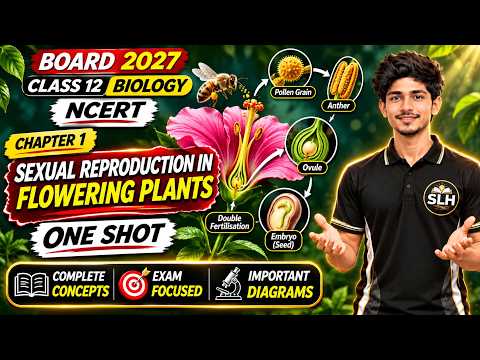
▶ Class 12 Biology Chapter 1 | Sexual Reproduction in Flowering Plants | NCERT One Shot · 28 min
Diagrams (tap & zoom)
Detail: Stamens together form the androecium, and carpels together form the gynoecium. Pollen (male gametophyte) is formed in the anther; the embryo sac (female gametophyte) is formed in the ovules of the ovary. After fertilisation, ovule → seed and ovary → fruit.
Original SLH diagram · Labelled diagram: longitudinal section of a flower showing stigma, style, ovary with ovules, anther, filament, petal, sepal, thalamus and pedicel.
Detail: The nucleus of the functional megaspore undergoes 3 rounds of free-nuclear mitosis → 8 nuclei. When cell walls form, 7 cells result: egg apparatus (3), antipodals (3) and central cell (1, containing 2 polar nuclei). Hence a typical angiosperm embryo sac is 8-nucleate and 7-celled (monosporic development, Polygonum type).
Original SLH diagram · Labelled diagram of a mature embryo sac: filiform apparatus and two synergids plus egg cell at the micropylar end, two polar nuclei in the central cell, three antipodal cells at the chalazal end.
Detail: Syngamy forms the zygote (2n) and triple fusion forms the primary endosperm nucleus (3n). The central cell becomes the PEC (primary endosperm cell). Double fertilisation is a distinctive feature of angiosperms.
Original SLH diagram · Four-step diagram: pollen tube enters a synergid, releases two male gametes, one fuses with the egg forming a diploid zygote, the other fuses with two polar nuclei forming the triploid primary endosperm nucleus.
Detail: Wall layers (outside to inside): epidermis → endothecium → middle layers → tapetum. The tapetum nourishes the developing pollen. Each cell of the sporogenous tissue is a potential microspore mother cell (PMC); the PMC undergoes meiosis (microsporogenesis) to form a microspore tetrad, which develops into pollen grains.
Original SLH diagram · Labelled transverse section of a young bilobed dithecous anther with four microsporangia, each showing epidermis, endothecium, middle layers, tapetum and central sporogenous tissue, joined by a connective with a vascular bundle.
Detail: The funicle attaches the ovule to the placenta; the point of attachment is the hilum. In an anatropous ovule the body is inverted, so the micropyle lies close to the funicle — the most common type in angiosperms. After fertilisation, integuments → seed coat, ovule → seed.
Original SLH diagram · Labelled longitudinal section of an anatropous ovule showing funicle, hilum, micropyle, outer and inner integuments, nucellus, embryo sac and chalaza.
Important questions with answers
Q1. What is double fertilisation?
Two fusions occur inside one embryo sac: the first male gamete fuses with the egg (syngamy → diploid zygote) and the second male gamete fuses with the two polar nuclei (triple fusion → triploid primary endosperm nucleus). Because two fusions occur, it is called double fertilisation; it occurs only in angiosperms.
Q2. What is the exine of a pollen grain made of?
The exine is made of sporopollenin, the most resistant organic material — even high temperatures, strong acids and alkalis cannot break it down. Sporopollenin is absent at the germ pores.
Q3. What is the difference between geitonogamy and xenogamy?
In geitonogamy, pollen goes to the stigma of another flower of the same plant — functionally cross-pollination but genetically similar to self-pollination. In xenogamy, pollen goes to a flower of a different plant, so genetically different pollen is received.
Q4. What is apomixis and what is its advantage?
Formation of seeds without fertilisation is apomixis — a form of asexual reproduction that mimics sexual reproduction. If apomixis is introduced into hybrid seeds, farmers can retain the same characters without buying new hybrid seeds every year.
UP Board previous year questions (2022–2026)
These questions are from real UP Board Intermediate papers (copies from a third-party archive, read and verified by SLH). Also shown: in how many 2022–2026 papers (different sets) a question from this topic appeared. See year-wise papers →
- “Which of the following characteristics of a flower is suitable for insect pollination? (A) Light weighted pollen grains (B) Coloured attractive corolla (C) Multiple ovule (D) Small pollen grains”
UP Board 20261 marksQuestions from this topic: 20 papers (2022, 2023, 2024, 2025, 2026) - “Describe the false fruit with a diagram.”
UP Board 20263 marksQuestions from this topic: 11 papers (2022, 2023, 2024, 2025, 2026) - “Write explanatory notes on: Polyembryony”
UP Board 20262.5 marksQuestions from this topic: 11 papers (2022, 2023, 2024, 2025, 2026) - “The ovule is attached to the placenta by means of a stalk called (A) Hilum (B) Funicle (C) Embryo sac (D) Nucellus”
UP Board 20261 marksQuestions from this topic: 10 papers (2022, 2023, 2024, 2025, 2026) - “What is microsporogenesis? Describe microsporogenesis in an angiospermic plant with a diagram.”
UP Board 20265 marksQuestions from this topic: 10 papers (2022, 2023, 2024, 2025, 2026) - “The endosperm of angiospermic plant is (A) Haploid (B) Diploid (C) Triploid (D) Tetraploid”
UP Board 20251 marksQuestions from this topic: 10 papers (2022, 2023, 2024, 2025) - “What is double fertilization? What is its importance?”
UP Board 20253 marksQuestions from this topic: 10 papers (2022, 2023, 2024, 2025)
Practice quiz
Tap an option — get instant right/wrong feedback and an explanation. Wrong answers are saved in "My mistakes".
1. Of which substance is the exine of a pollen grain made?
2. How many cells and nuclei are there in a typical angiosperm embryo sac?
3. Which agent brings about pollination in Vallisneria?
4. What is formed by triple fusion?
5. Which layer of the anther wall nourishes the developing pollen?
6. Which of these is a false fruit?
7. In which plant are cleistogamous flowers found?
8. What is coconut water?
Quick revision checklist
Before the exam — try explaining each topic aloud for 1 minute. If you get stuck, reread it in the notes above.
- Parts of a flower
- Structure of the anther
- Microsporogenesis
- Pollen grain
- Ovule (बीजांड)
- Megasporogenesis + embryo sac
- Types of pollination
- Agents of pollination
- Outbreeding devices
- Artificial hybridisation
- Double fertilisation (दोहरा निषेचन)
- Endosperm, embryo, seed
- Fruit
- Apomixis & polyembryony